

Tazio Trends: Drowning in applications? High-volume graduate hiring doesn’t have to be hellish

We’ve all seen the news stories – young people are applying for jobs en masse and experiencing repeated rejection or, worse, silence. And Alan Milburn's report into Neets has heightened the focus on the challenges they face finding work.
The latest Office for National Statistics figures show vacancies are down to 691,000, a 2.9% decrease from the previous quarter. While the Institute of Student Employers’ 2026 Student Recruitment Report says competition for jobs is at a record high with 141 applications per graduate role and 96 per apprenticeship position.
As well as ramping up workloads this is making it harder for recruiters to pinpoint the people they need. A survey by LinkedIn revealed that 79% found it increasingly challenging to identify the right candidates and 60% of respondents to the ISE survey said managing applicant volumes is a top concern for the next five years.
Given the prevalence of easy apply options and AI-powered CVs, not to mention the desperation to land your first job in a tough market, it’s no surprise applicant volumes haven’t dropped since we last wrote about the subject.
The pitfalls of high-volume recruitment
If recruitment processes aren’t reshaped to address ongoing high volumes, the fallout impacts job seekers and recruiters in numerous ways:
- Recruiters become overwhelmed
When hundreds or thousands of applications arrive in a short period, recruiters spend most of their time reviewing CVs, checking eligibility and managing administration rather than engaging with the strongest candidates.
- Great candidates get lost in the crowd
High-potential applicants risk being overlooked when assessment methods aren't designed to efficiently identify capability and fit at scale.
- Candidate experience suffers
Long response times, limited communication and complex processes frustrate applicants and damage employer reputation.
- Hiring decisions take longer
Bottlenecks throughout the recruitment process, increase time-to-hire and create additional pressure on hiring managers.
- Diversity goals can stall
When organisations rely heavily on CV screening or manual review, unconscious bias and inconsistent decision-making become more difficult to control. Time pressure leads to instinctive, rather than rational, decisions.
Employers are responding
Many employers recognise these issues and are taking steps to address them in their recruitment processes. The ISE found that over the next three to five years, 45% expect increased use of data and technology in recruitment decision-making and 43% anticipate greater use of skills-based hiring.
77% of employers are also redesigning or reviewing recruitment processes in response to candidate use of generative AI. This doesn’t mean they are banning it, after all AI is now a part of life and work, however many are providing guidance on how and when to use it.
It’s not just AI that is making it hard to differentiate candidates, the graduate and internship opportunities that help people stand out have decreased by 8%. That means less candidates are applying with experience that would otherwise have been used as a barometer of potential.
In this landscape employers need better ways to assess talent says CEO Tom Stroud:
"The rise of AI-generated applications is accelerating a shift that was already under way. Employers are placing less emphasis on what a candidate has done before and more emphasis on what they can do, how they think and how they are likely to perform in the role."
From 14,000+ applications to hundreds of high-quality hires
We see the advantages of this approach every day. For example, we’ve been working with a large utility company across its recruitment operations, including its emerging talent campaigns which includes graduate and apprenticeship hiring.
Faced with more than 14,000 applications the organisation needed a faster and fairer way to identify potential. Our platform helped it move away from manual CV screening and introduced a recruitment process focused on skills, behaviours and aptitudes that made potential the defining measure of success.
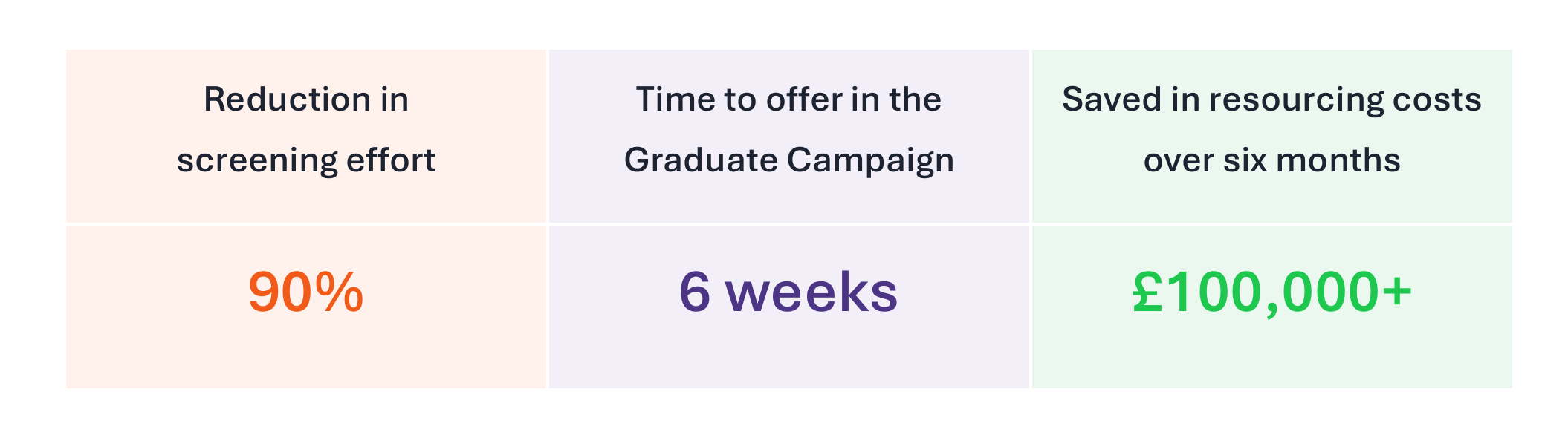
The results have included headline-grabbing time and cost savings. But most importantly for the business the Tazio platform identified people with the ability to succeed. A hiring manager at the company said: “There has been a marked improvement in the quality of candidates this year.”
It has also found talent that may otherwise have been overlooked such as care leavers, neurodiverse individuals and a candidate who has experienced homelessness. For many of those that weren’t successful a ‘no’ became a ‘not yet’ with 65% of applicants retained in talent pools.
Read the full case study here for an in depth look at how the organisation’s hiring was transformed.
At a time when high applicant volumes are turning recruitment into an unsatisfactory slog for candidates and recruiters, organisations are increasingly turning to this kind of innovation to improve experiences for everyone.
As always, our mission is to empower you to make smarter, faster hiring decisions and create exceptional experiences for your candidates. Stay connected with us on LinkedIn for the latest news and resources.
If you have any thoughts on this edition of Tazio Trends or want to find out more about our platform, it would be great to hear from you.


